
A History of Fire Protection
Fire protection has evolved for nearly a thousand years – and so has the responsibility to get it right.
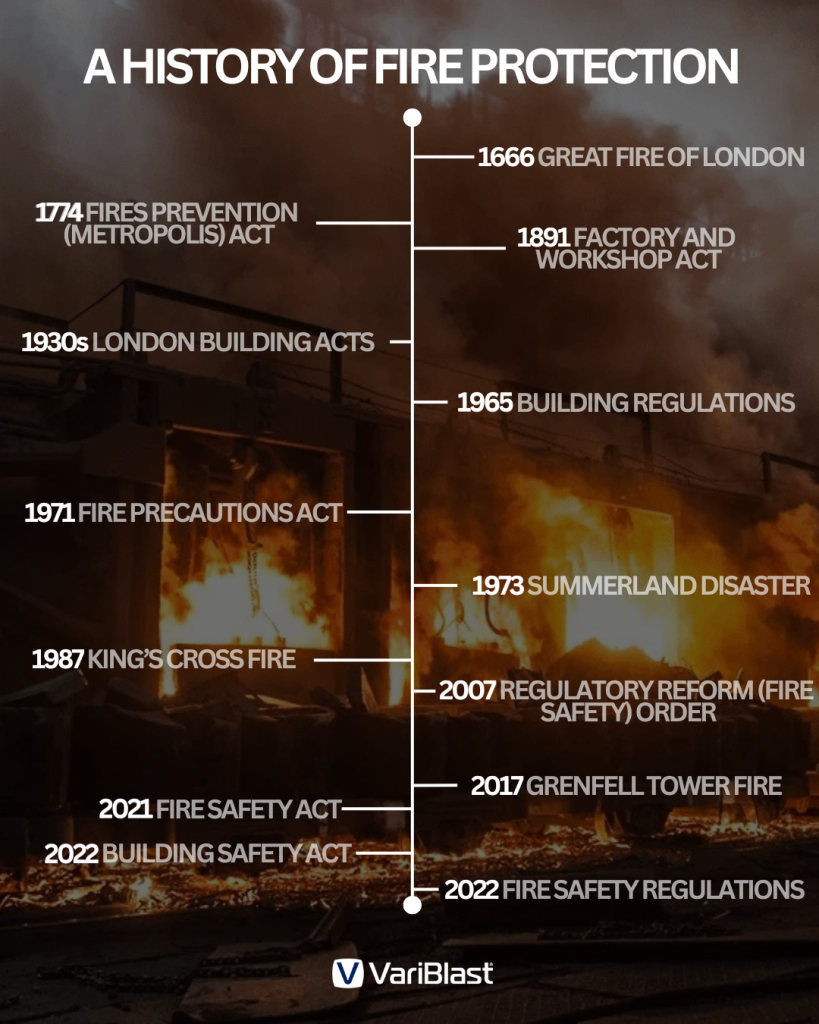
This graphic traces the major milestones in fire-safety legislation, from the Great Fire of London to the latest reforms following the Grenfell Tower tragedy. Understanding this history explains not only how modern standards came to be, but why strict compliance is essential today.
To go into more depth, here are the major landmarks that either provoked or demonstrate changes to fire safety and legislation since the 12th century:
12th Century
The Mayor of London ordered the use of stone over timber for building and banned thatched roofs.
14th Century
Open hearths were being moved from the centre of rooms to against walls, and rudimentary chimneys were introduced.
1666 Great Fire of London
This disaster was a pivotal moment in UK fire safety. It exposed the danger of narrow, overcrowded streets and timber-framed buildings. In response, King Charles II mandated that all new buildings be constructed from fire-resistant materials like brick and stone, and streets were widened.
1774 Fires Prevention (Metropolis) Act
More than a century after the Great Fire, this act classified buildings by construction type and imposed size limits on factories and warehouses. Crucially, it was the first legislation to address the safety of human life and means of escape, not just property protection.
Late 19th-century mills
The introduction of cast-iron and brick construction in multi-story textile mills marked the beginning of modern “fireproof” building. This expensive practice was initially adopted by major manufacturers to replace mills that had burned down.
1891 Factory and Workshop Act
This legislation extended fire safety to the workplace by requiring proper means of escape.
1930s London Building Acts
These acts described new features for “means of escape” but faced resistance from local authorities. The Factories Act of 1937 expanded on earlier legislation, requiring fire escape plans and early “fire certificates”.
1965 Building Regulations
The first comprehensive building regulations for England and Wales were created, which incorporated fire safety rules on materials, escape routes, and fire service access into a single, legal document.
1971 Fire Precautions Act
Triggered by several fires in the 1960s, this landmark act required fire safety inspections and certificates for public buildings like hotels and factories.
1973 Summerland Disaster
The fire at a leisure complex on the Isle of Man, caused by highly flammable building materials, led to stricter fire risk assessments.
1987 King’s Cross Fire
This underground station fire resulted in 31 deaths and highlighted the need for new regulations for sub-surface railway stations, prompting the 1989 Fire Precautions (Sub-surface Railway Stations) Regulations.
2005 Regulatory Reform (Fire Safety) Order (FSO)
This was a major shift away from prescriptive fire certificates. It consolidated existing legislation and introduced a risk-assessment-based regime, placing the responsibility for fire safety on a “responsible person” for all non-domestic premises.
2017 Grenfell Tower Fire
The fire at Grenfell Tower exposed critical failures in modern high-rise building regulations, especially concerning external cladding.
2021 Fire Safety Act
Expanded the scope of the FSO to include the external walls (cladding and balconies) and flat entrance doors of multi-occupied buildings.
2022 Building Safety Act
Introduced sweeping reforms for “higher-risk” buildings over 18 meters tall, establishing a new Building Safety Regulator and mandating tougher, continuous safety assessments. The act banned combustible cladding and established a “golden thread” of digital information about a building’s fire safety.
2022 Fire Safety (England) Regulations
Implemented specific recommendations from the Grenfell Tower Inquiry Phase 1 report, mandating duties for responsible persons in residential buildings.
As specialists in surface preparation and the removal of both outdated cementitious fireproofing and modern intumescent coatings, we support clients in meeting these evolving regulations with confidence. Our expertise ensures that structures are safely stripped back, fully prepared, and ready for compliant, high-performance fire protection systems that align with the expectations of today’s Building Safety Regulator.
Whether upgrading ageing assets or preparing new works, we bridge historical insight with modern best practice – helping ensure that every coating applied today stands up to the lessons learned over centuries of fire-safety development.